Temples in Leopard Country: Devgiri and the Shrines Inside the Hills
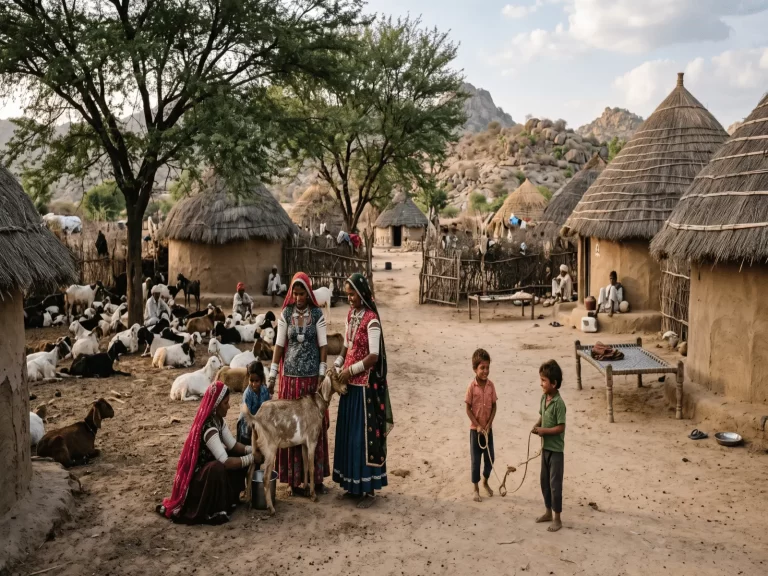
Most guidance about responsible behavior in Jawai focuses, understandably, on wildlife: keep your distance from a resting leopard, do not ask a driver to get closer than the rules allow, do not use a flash near an animal at dusk. Far less is written about how to conduct yourself around the Rabari community whose land you are moving through on the way to that leopard sighting, and this gap is worth closing directly, because the behavioral standard here matters just as much, and the consequences of getting it wrong fall on real people rather than an abstraction. This piece sets out, plainly and practically, how we expect guests to conduct themselves around Rabari individuals and settlements, on safari and during any arranged visit.
The Core Principle: People, Not Scenery
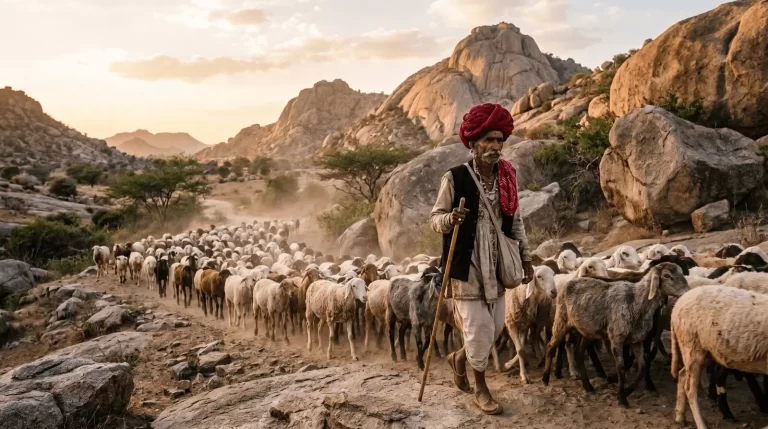
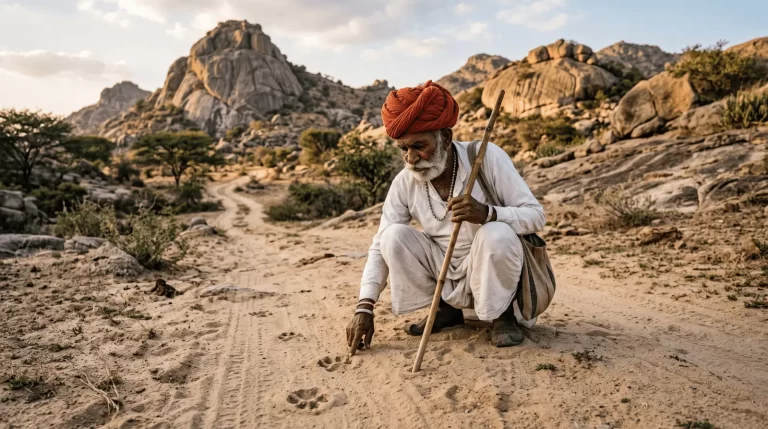
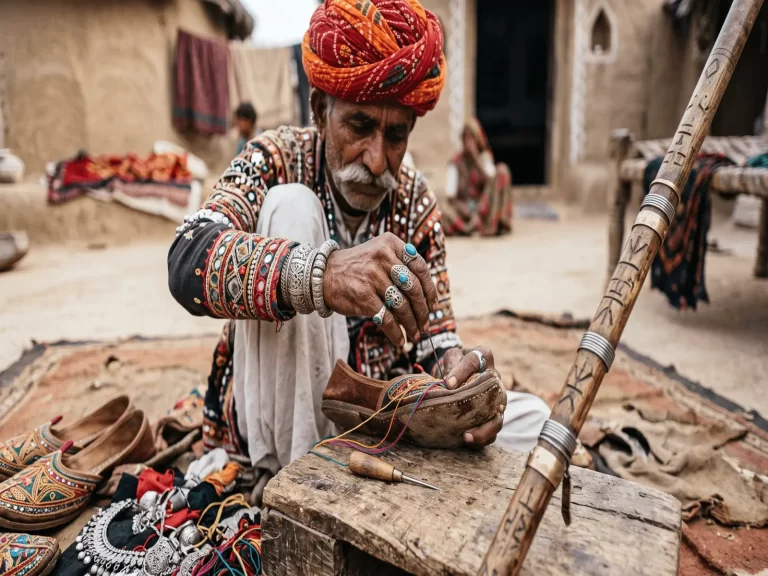
The single most important shift in mindset a visitor can make is this: a Rabari herder walking with goats along a ridge, or a woman working at a loom or embroidery frame outside her home, is a person going about an ordinary day, not a photogenic feature of the landscape placed there for a passing vehicle’s benefit. It is easy, in the excitement of a safari drive, to treat every striking sight, a leopard, a granite formation, a herder in distinctive dress, as equally available for photographing on sight. They are not equivalent. Wildlife photography carries its own ethical standards, covered elsewhere on this site, but photographing a person carries an additional, non-negotiable requirement that a landscape or an animal does not: that person’s consent.
Photography of People: What Consent Actually Requires
Consent for a photograph of a specific individual means that person has been asked, has understood what is being asked, and has agreed, in the moment, freely and without pressure. It does not mean a general awareness that tourists sometimes take photographs in this area. It does not mean the driver or guide said it would probably be fine. It does not mean the person did not visibly object, since visible objection is not the same as agreement, and many people, especially in a community regularly exposed to outside visitors, may not feel able to object clearly to a stranger holding a camera even if they are uncomfortable. The responsibility sits with the visitor to ask clearly, through a guide or host who can translate if needed, and to accept a no, or an ambiguous response treated as a no, without pressing further or attempting to get the shot anyway from a different angle.
This applies with particular weight to children. Do not photograph Rabari children without a parent or guardian’s clear, specific consent, and do not offer sweets, money, or small gifts to children as a way of prompting a photograph or a friendly reaction, a practice that creates uncomfortable begging dynamics in communities regularly visited by tourists and that we ask every guest to avoid entirely. If a genuine, warm interaction happens naturally, through a host-mediated visit, with full family awareness and consent, that is a different matter entirely from an unplanned roadside photograph taken because a child happened to be visible and looked appealing through a viewfinder.
Long-Lens Photography and the Illusion of Distance
A specific problem worth naming directly: a long telephoto lens, the same equipment many guests bring for leopard photography, makes it possible to photograph a person from far enough away that it may not feel, to the photographer, like an intrusion at all. It is still an intrusion. Photographing a herder or a settlement from a distance with a long lens, without any conversation, without any consent, without the subject necessarily even aware a photograph is being taken, is not made acceptable by the physical distance involved. The same standard applies regardless of how far away the camera is: a person should have the opportunity to know they are being photographed and to decline, and a long lens should not be used as a workaround for skipping that step.
On Safari: What to Expect and How to Behave
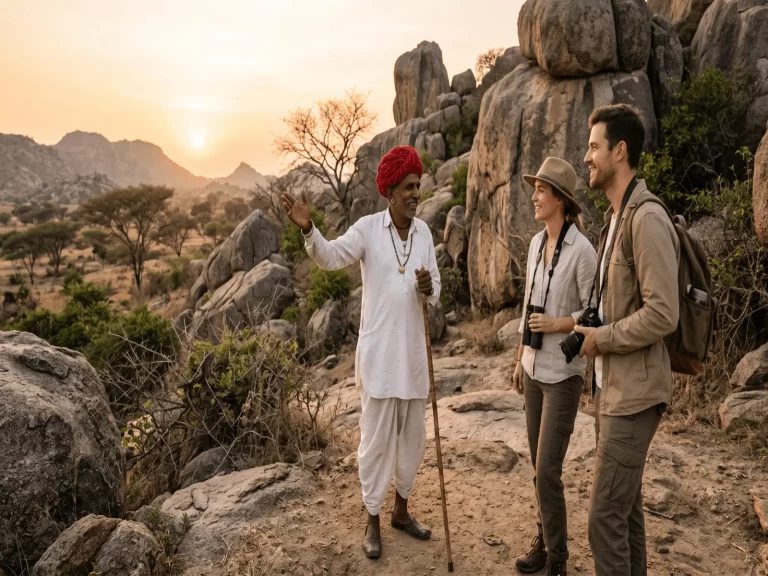
During an ordinary safari drive, you will likely pass Rabari herders, settlements, and livestock as a normal part of the landscape, since safari routes run through the same open terrain the community uses daily. This is not, itself, an invitation to stop the vehicle, approach on foot, or request photographs, unless your guide indicates that a brief, respectful acknowledgment or a wave is welcome, which is often the full extent of appropriate contact during a routine drive. Guides operating under the current registered, GPS-tracked safari framework are expected to model this behavior, and a good guide will not encourage guests to press for more contact or photography than the situation naturally invites. If a guide does encourage inappropriate behavior toward the community, that is worth raising directly, since it reflects poorly on the operator’s broader standards, not just this one moment.
During an Arranged Village Visit
Where a properly arranged, consent-based village visit is part of your itinerary, a different, more detailed set of expectations applies, covered in full elsewhere on this site. In brief: follow your host’s lead on where to walk and what to look at, ask before photographing any individual, accept that some spaces and activities are simply not open to visitors regardless of how interesting they look, and treat the visit as time spent as a guest in someone’s home and workplace rather than a tour through an exhibit. Bring genuine curiosity and willingness to ask respectful questions through your host rather than arriving with a fixed shot list to complete. The value of the visit, for you and for the household hosting it, comes from treating it as a real social interaction rather than a content-gathering exercise.
Clothing, Behavior, and General Respect
Modest dress is appropriate when visiting a Rabari settlement, in line with general rural Rajasthani norms; loose, covering clothing is more appropriate than beachwear or overly casual dress designed for a different kind of holiday. Removing footwear before entering a home, if invited to do so, and accepting offered tea or hospitality graciously, even a small amount if you are not thirsty, are small gestures that matter more than they might seem to an outside visitor. Avoid public displays of affection, loud conversation, or behavior that would read as disruptive in any rural community setting anywhere, and take direction from your host on specific local expectations you would not otherwise know to anticipate.
What Not to Do, Stated Directly
A short, direct list is more useful here than a long explanation: do not photograph anyone without asking first and accepting their answer. Do not offer money, sweets, or gifts to children to prompt a reaction or a photograph. Do not enter homes, enclosures, or private spaces without explicit invitation. Do not ask community members to pose, dress differently, or perform an activity for a better photograph. Do not treat a village visit as a checklist item to complete quickly before moving to the next stop. Do not assume a general visit arrangement means every individual present has agreed to be photographed or engaged with. And do not press for access, a photograph, a longer visit, or a different experience than what has been arranged, if your host indicates that what is available is what is appropriate for that day.
Vehicle and Road Etiquette Near Settlements
Safari tracks and access roads in Jawai frequently run close to Rabari settlements and grazing areas, and how a vehicle behaves in these stretches matters beyond the immediate question of photography. Slow down when passing herders and livestock on foot, both for safety, since a startled or displaced herd is a real practical problem for the herder managing it, and out of basic consideration for people going about their work on a road that is functionally shared space rather than a dedicated tourist corridor. Avoid loud music, honking, or raised voices from within the vehicle as you pass through or near a settlement. Do not ask your driver to stop the vehicle specifically so passengers can photograph a settlement or its residents from the road; if a stop happens, it should be because your guide has judged it appropriate and has an existing basis for the interaction, not because a guest requested a photo opportunity on the spot. These may seem like minor points next to the larger questions of consent and respect already covered, but cumulative small intrusions from a steady stream of safari vehicles are precisely the kind of pressure that erodes a community’s willingness to remain open to visitors over time, and avoiding that erosion is a shared responsibility between operators and guests.
Why This Standard Exists
None of this guidance exists to make a visit more difficult or less rewarding. It exists because the Rabari community’s willingness to host any visitor at all rests on trust that visitors will behave the way this piece describes, and that trust is genuinely fragile in the way any relationship between a community and a stream of outside visitors can be. A single visitor behaving badly, pressing for photographs without consent, treating people as scenery, disrupting a household’s ordinary day for a better shot, can damage a relationship that took years to build and that many future visitors depend on continuing. Respecting these standards is not a constraint on having a meaningful experience in Jawai. It is, in a very direct sense, what makes a meaningful experience possible at all, both for you and for the community whose land and daily life you are, briefly and by invitation, sharing.
Message us on WhatsApp for current pricing and a quote tailored to your dates and group size.