Rabari Village Walk: What the Experience Includes and How to Do It Respectfully
The question comes up on almost every safari: why haven’t the Rabari simply removed the leopards, the way retaliatory killing has thinned or eliminated predator populations near livestock-keeping communities in so many other parts of the world? It is a fair question, and it deserves a real answer rather than a comforting one-line summary. The honest answer is that Jawai’s coexistence is not the product of a single cause. It rests on at least two distinct forces that appear to reinforce each other over a long period: a practical calculus in which tolerance has historically made more sense than retaliation, and a cultural and, for some families, religious regard for the leopard that predates any modern conservation framing. Understanding both, and understanding where the honest limits of that understanding are, is the point of this piece.
The Practical Case for Tolerance
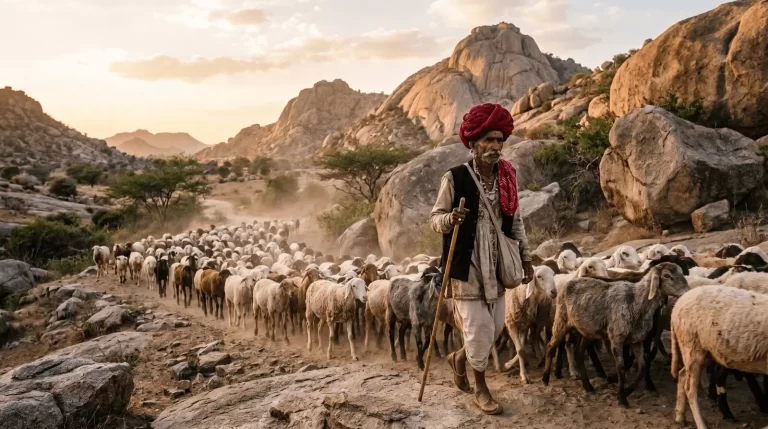
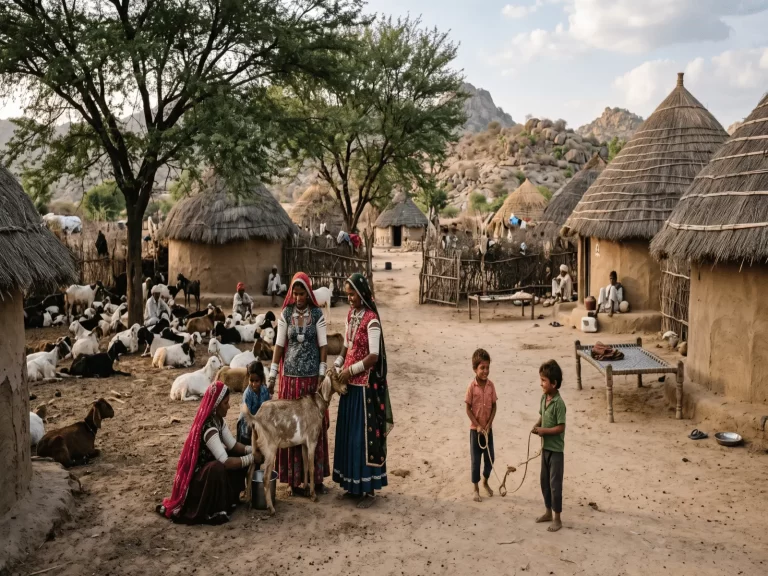
Start with the economics and risk calculus a herding household actually faces. Losing a goat or sheep to a leopard is a real cost, but it is a bounded one: a single animal, occasionally more in an unusual incident, weighed against a herd that also faces disease, drought, theft, and the ordinary attrition of open-range grazing in a harsh, semi-arid landscape. Retaliation against a leopard, by contrast, carries costs and risks that are harder to bound. Direct confrontation with a leopard is physically dangerous. Leopards are protected wildlife under Indian law, meaning killing one carries serious legal consequences that a herding family, already operating on thin margins, has strong reason to avoid. And there is a less tangible but consistently described risk: a sense, expressed by long-term observers of the community, that provoking conflict with the resident wildlife would destabilize an arrangement that has otherwise worked for the community for a very long time.
Set against this, the practical benefit of retaliation is genuinely unclear. Killing one leopard does not remove the underlying reality that this landscape supports a resident leopard population living on the same granite hills the community grazes; another leopard occupies contested territory relatively quickly in a healthy population, meaning retaliatory killing does not durably solve the loss it is meant to prevent. Herders who have spent a working lifetime observing this landscape are, in effect, already operating with something close to this understanding: the leopard is a permanent feature of the terrain, not a removable nuisance, and the rational long-term response to a permanent feature of the terrain is to build a way of living around it rather than to fight a battle that has to be refought indefinitely.
The Cultural and Religious Dimension
Alongside this practical calculus sits a genuine cultural and, for some Rabari families, religious regard for the leopard, rooted in broader regional traditions across Rajasthan that hold wildlife, and particular animals in particular, in specific esteem. This is not a single, uniform belief recited identically across every household. Belief and practice vary by family, by generation, and by individual, in the same way religious and cultural practice varies within any community anywhere. Where this regard exists, it is genuine and long-standing rather than a modern invention adopted for tourism purposes, and it deserves the same seriousness any other community’s spiritual or cultural framework would be given by an outside writer, rather than being treated as a charming detail that explains everything.
It would be a mistake, and this site is careful to avoid it, to present this cultural regard as the single, tidy explanation for the entire coexistence pattern, as though the Rabari simply hold a belief that leopards are sacred and that belief alone accounts for generations of tolerance. The honest picture is more layered: cultural regard likely made tolerance easier to sustain and pass down through generations, while lived practical experience, tolerance turning out to be survivable and even beneficial over time, likely reinforced and deepened that cultural regard rather than the belief existing in isolation from lived reality. Cause and effect between the two are genuinely difficult to separate from the outside, and honest coverage of Jawai should say so rather than pretend the answer is simpler than it is.
What Sustained Tolerance Actually Requires
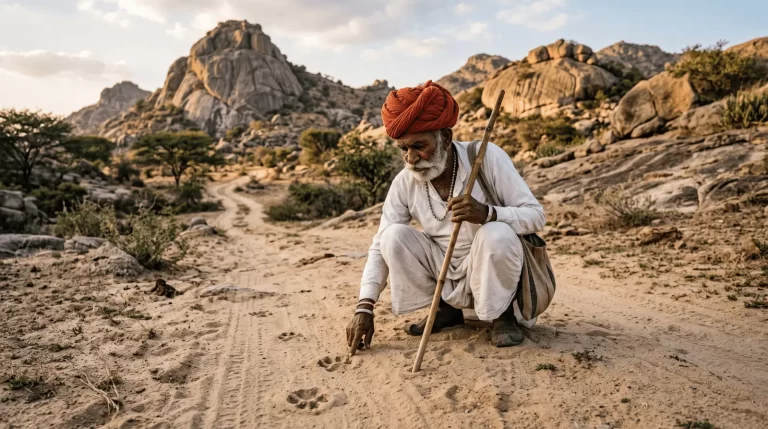
It is worth being specific about what “tolerance” has meant here in practice, because the word can sound passive when the reality is more active than that. Sustaining this pattern across generations has required herders to develop genuine, working knowledge of leopard behavior and territory, not to avoid the animal entirely but to coexist with it functionally: knowing which outcrops are likely to have a resting leopard, adjusting grazing routes accordingly where it is sensible to do so, and generally treating the leopard’s presence as a fact to work around rather than a threat to eliminate. This is a learned skill, refined and passed down the same way any other piece of terrain literacy is passed down within a herding family, and it represents active management of a shared landscape rather than passive acceptance of whatever happens.
It has also required, at the community level, a sustained decision, repeated across generations and individual households, not to escalate isolated incidents of livestock loss into a pattern of retaliation. This is not guaranteed by anything external. There is no fence, no bounty enforcement, no formal contract binding any individual herder to this behavior. It has held because enough individual households, across enough individual incidents over a long enough period, made the same judgment independently, and because the cultural and religious framework around them supported rather than undermined that judgment. That is a genuinely unusual, and genuinely fragile-sounding, foundation for something that has nonetheless proven remarkably stable.
Where the Understanding Has Real Limits
Honest coverage of this topic requires acknowledging what is not fully known or verifiable from the outside. The precise balance between practical tolerance and cultural regard in any individual household’s thinking is not something an outside writer, however well informed, can measure or claim to fully understand. Attitudes almost certainly vary across individual families, across generations within the same family, and across the specific circumstances of any given loss. A family that has lost several animals in a short period may feel differently, even if their behavior does not change, than a family that has gone years without a loss. Younger generations, increasingly connected to urban work, education, and a wider range of economic options than their parents had, may hold a different relationship to both the practical calculus and the cultural framework than older generations do, and that generational shift is a live, ongoing question rather than a settled one.
It is also worth stating plainly that this coexistence, however remarkable, is not evidence that human-wildlife conflict is easily solved elsewhere by simply encouraging tolerance. Jawai’s specific combination of open, visible terrain, a particular cultural and religious context, a livestock economy that can absorb bounded losses, and a very long history of shared occupation without an external displacement event are specific conditions that do not transfer automatically to other landscapes with different histories, different economics, or different predator behavior. Conservation researchers who study Jawai are generally careful to describe it as an instructive case rather than a template that can be copied wholesale elsewhere, and this site follows that same caution rather than overselling Jawai as a simple solution to a genuinely difficult global problem.
How This Compares to What Usually Happens Elsewhere
It is worth briefly contrasting this pattern with the more common global default, because the contrast is what makes Jawai notable in the first place. In many landscapes where large predators live near livestock-keeping communities, an isolated loss can trigger an immediate, individual retaliatory response, a trap set, poison laid out, or a hunt organized, often justified as necessary protection rather than punishment. Over time and across many such individual responses, this pattern can measurably reduce local predator populations, sometimes to the point of local extinction, even where the species is formally protected on paper. This is a well-documented dynamic across leopard, tiger, wolf, and large carnivore ranges worldwide, and it is generally treated by conservation researchers as the expected, rational response of a community absorbing repeated economic losses without strong countervailing reasons not to retaliate.
Jawai’s pattern is notable specifically because the countervailing reasons here, the practical calculus and the cultural regard described above, have consistently outweighed the pull toward retaliation across a long enough period, and across enough individual households, that the absence of retaliatory killing has become the expected norm rather than a fragile exception. This does not mean tension or frustration around livestock loss is absent at the individual, household level. It means that whatever frustration exists has not translated into the kind of individual retaliatory action that erodes predator populations elsewhere. That distinction, between an absence of frustration and an absence of retaliatory action despite frustration, is closer to what is actually being described here, and it is a more honest and more interesting claim than a simpler story of a community that simply loves leopards without reservation.
Why This Still Matters
None of these caveats make the coexistence less remarkable. If anything, understanding how fragile and layered its foundations actually are makes the outcome more impressive, not less: a community facing real economic pressure from livestock loss has sustained, across generations, a pattern of tolerance that required active daily judgment, cultural reinforcement, and a level of restraint that has simply not held in most comparable landscapes elsewhere in the world. That is worth respecting on its own terms, and it is worth protecting, which is part of why this site treats any visitor access to Rabari life and land with the same seriousness the community itself has brought to sharing it with a wild predator for so long.
Message us on WhatsApp for current pricing and a quote tailored to your dates and group size.