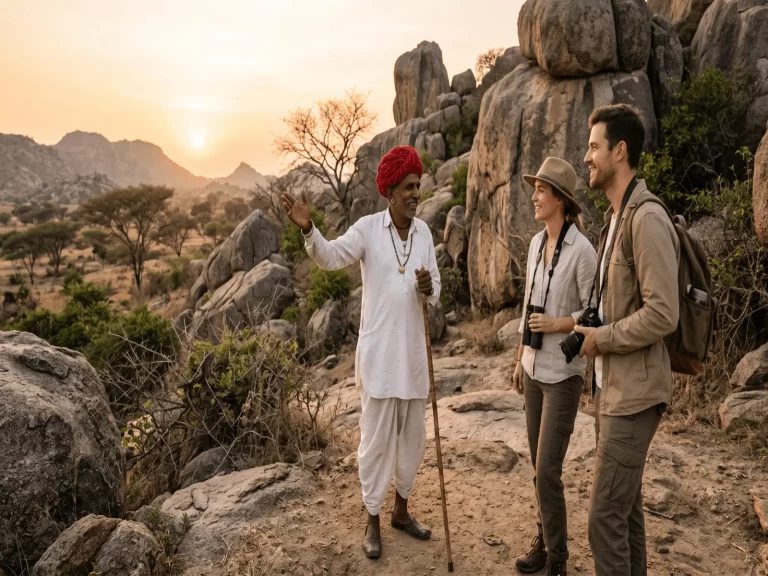
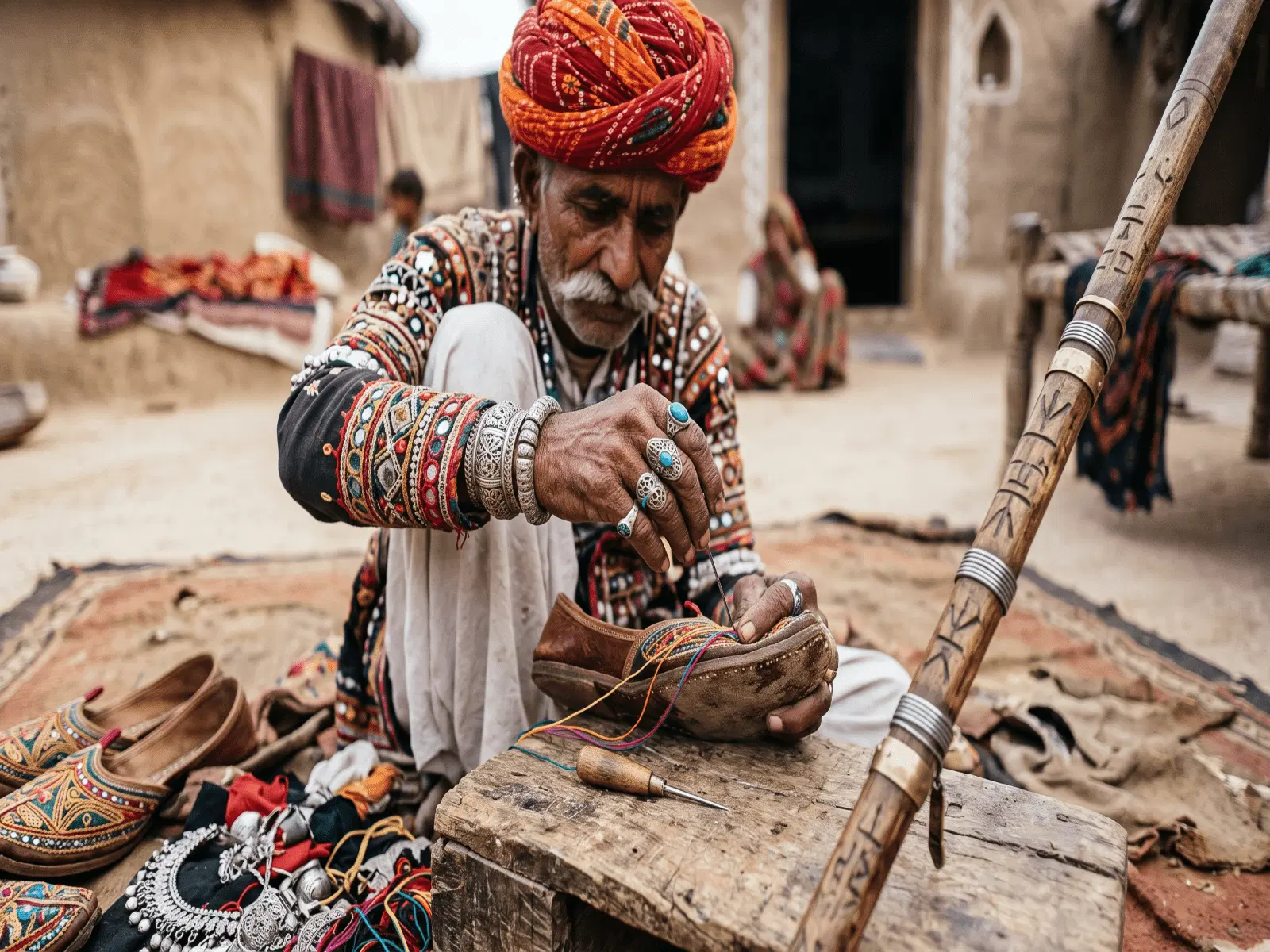
Photographing Rabari Life: Consent, Respect and the Shots Worth Taking
Human-wildlife conflict is, globally, one of the most persistent obstacles to large carnivore conservation. Wherever people and predators share land, and increasingly they must, given how little undisturbed wilderness remains, livestock loss tends to produce retaliation: trapping, poisoning, shooting, or organized culling, often justified as necessary protection of livelihood rather than punishment. Jawai’s pattern, a resident leopard population living for generations alongside a pastoral community without a recorded history of retaliatory killing, stands out sharply against that global default. This piece looks at why researchers and conservationists treat Jawai as a notable case study, how it compares to better-known conflict zones elsewhere, and where the comparison has real limits.
The Global Default: Retaliation as the Common Response
Across much of Africa, large carnivore populations, lions, leopards, hyenas, and others, have been reduced substantially outside formally protected reserve boundaries, in significant part due to retaliatory killing by livestock-keeping communities responding to real, repeated economic losses. Communities living adjacent to reserves in parts of Kenya, Tanzania, Namibia, and elsewhere have documented histories of poisoning carcasses to kill returning predators, organized hunts following a serious loss, or engagement of professional hunters and, more recently, conservation-funded compensation and livestock-guarding programs specifically designed to counteract this pattern. In North America, wolf populations have faced sustained pressure from ranching communities for well over a century, with government-sponsored eradication programs in earlier decades and ongoing conflict today over reintroduction and management in ranching states. In parts of Europe, brown bear and wolf populations returning to landscapes after decades of absence have triggered fresh conflict with sheep-farming communities unaccustomed to living alongside large predators after generations without them.
Within India specifically, human-wildlife conflict involving leopards and tigers is a serious, ongoing issue in numerous states, with documented incidents of retaliatory killing, mob violence against captured or cornered animals, and communities petitioning forest departments for predator removal following livestock or, in more serious cases, human injury or death. Uttarakhand, parts of Maharashtra, and several other states have experienced significant tension between expanding or persisting leopard populations and adjacent human settlements, sometimes escalating to serious violence against the animal. This is the backdrop against which Jawai’s pattern reads as genuinely unusual rather than simply pleasant.
What Makes Jawai Different
Several factors, in combination, appear to distinguish Jawai from these more conflict-prone landscapes, though it is worth stating clearly that this is an area of ongoing research interest rather than a fully settled scientific consensus. The open, exposed granite terrain means leopards here are unusually visible compared to forest-dwelling leopard populations elsewhere, which may reduce the element of surprise or sudden, startling encounter that can heighten fear and hostility in more forested conflict zones. The very long history of shared occupation, without a displacement event in which either the human settlement or the leopard population expanded suddenly into previously separate territory, may matter considerably; much of the conflict literature elsewhere describes situations where a predator population recovers or expands into an area that had grown unaccustomed to living alongside it, or where human settlement expands into previously separate wildlife habitat, both of which create friction that a long-stable, mutually adapted arrangement like Jawai’s does not have to overcome.
The specific cultural and religious regard some Rabari families hold toward the leopard, discussed in more depth elsewhere on this site, is also a meaningful factor distinguishing Jawai from communities where no comparable cultural framework exists to counterbalance the economic pressure of livestock loss. And the specific economics of Rabari herding, a livestock mix and herd management approach that has, historically, been able to absorb the bounded cost of occasional predation without the loss threatening a household’s survival outright, likely matters as well; conflict tends to intensify in situations where predation threatens a family’s entire economic base rather than representing a manageable, if unwelcome, recurring cost.
The Cost of the Conflict Elsewhere
It is worth being specific about what is actually lost when retaliation becomes the norm, since the contrast with Jawai is otherwise abstract. In landscapes where retaliatory killing of leopards, tigers, or other large carnivores is common, local extinction of the predator population is a realistic and frequently observed long-term outcome, even where the species carries full legal protection on paper. Enforcement of wildlife protection law against individual, dispersed retaliatory killings in remote rural areas is notoriously difficult, meaning legal protection alone rarely prevents the pattern once it takes hold in a community. The conservation cost is not limited to the individual animals killed; a population that loses individuals faster than it can replace them through breeding and territorial dispersal can decline toward local extinction over a surprisingly short period, which is part of why conservation organizations invest so heavily in conflict-mitigation programs in affected regions, and part of why a landscape like Jawai, where this decline has simply not occurred, draws sustained research interest.
Comparable Cases Worth Knowing
Jawai is not entirely without parallel. Researchers studying human-wildlife coexistence, rather than conflict, have pointed to a small number of other landscapes worldwide where a broadly similar pattern of sustained tolerance exists, including some pastoral communities in parts of East Africa that maintain traditional, non-lethal responses to predator presence rooted in specific cultural frameworks, and isolated cases elsewhere in South Asia where particular religious or cultural traditions have historically discouraged killing specific wildlife species regardless of economic cost. These cases are studied precisely because they are exceptions to a much more common pattern of conflict, and Jawai is generally discussed within this same small, notable category rather than as an entirely unprecedented phenomenon. What distinguishes Jawai within even this select group is the specific combination of an unusually visible, open-terrain predator population and a documented multi-generational absence of retaliatory killing sustained without any formal enforcement mechanism requiring it.
Why Researchers Study Jawai Specifically
Conservation researchers and wildlife documentary makers have taken a specific interest in Jawai because it offers a real-world, long-running natural case study in what sustained tolerance actually requires and how it can be maintained without heavy-handed enforcement, fencing, or a fully resourced formal compensation apparatus standing behind it. Most conservation interventions aimed at reducing human-wildlife conflict elsewhere involve external design: livestock-guarding dog programs, predator-proof enclosure subsidies, compensation schemes, community education campaigns, all developed and often funded by outside conservation organizations responding to an existing conflict problem. Jawai represents something different: a pattern that developed independently, from within the community itself, over a long period, without an external conservation program engineering it into existence. That makes it valuable as a subject of study precisely because it demonstrates that sustained coexistence is possible under real-world economic pressure, even though the specific conditions that produced it in Jawai are not something a conservation program could simply replicate on demand elsewhere.
The Limits of the Comparison
It would be a significant overstatement, and this site is careful not to make it, to suggest that Jawai proves human-wildlife conflict elsewhere could be solved simply by encouraging communities to adopt greater tolerance. The conditions that appear to sustain Jawai’s pattern, the specific terrain, the specific cultural and religious context, the specific livestock economy, and the very long, undisturbed history of shared occupation, are not conditions that can be manufactured or transplanted into a different landscape with a different history, different economic pressures, and a different relationship between the community and the predator involved. A community facing sudden, unfamiliar predator expansion into a previously predator-free area, for instance, faces a fundamentally different psychological and practical situation than one, like Jawai’s Rabari community, that has known this predator as a permanent feature of the landscape for as long as living memory extends.
Researchers who study Jawai in comparative context generally treat it as an instructive case rather than a template, useful for understanding what factors can support tolerance and for informing conservation approaches elsewhere in a more nuanced way, rather than as a simple formula that guarantees the same outcome if copied. This site follows that same careful framing rather than presenting Jawai as proof that coexistence is easy or universally achievable wherever it is encouraged.
Media and Documentary Attention
Jawai’s coexistence story has drawn attention from wildlife documentary productions and international nature media over the past decade or so, a level of outside interest unusual for a landscape that is not a formally protected national park or tiger reserve. This attention has generally focused, appropriately, on the ecological and behavioral aspects of the story, how leopards use the open granite terrain, how the resident population has grown visible and relatively easy to observe compared to forest-dwelling leopards elsewhere, and how this connects to the human community sharing the same ground. It is worth noting, and this site takes the point seriously in its own coverage, that documentary and media attention carries its own risk of flattening a complex, lived reality into a tidy, emotionally satisfying narrative for an audience, sometimes at the expense of the more layered, harder-edged truth: that this is a community absorbing real economic loss, not a landscape where predator and herder have achieved some effortless harmony. Responsible coverage of Jawai, including this site’s own, tries to hold onto that complexity rather than repeating a simplified version because it is more compelling on screen or on the page.
Why the Comparison Still Matters
Understood with these limits in mind, the comparison remains genuinely valuable, both for conservation science and for a visitor trying to understand why Jawai draws the attention it does beyond its wildlife photography appeal. It demonstrates that sustained, generations-long tolerance between a large predator and a livestock-keeping community is possible, that it does not require an external enforcement apparatus to hold, and that the specific combination of practical and cultural factors behind it is worth studying carefully rather than assuming it will simply recur wherever conditions look superficially similar. For visitors, understanding this comparison is part of understanding why Jawai is treated by conservation researchers and long-term observers as one of the more remarkable human-wildlife landscapes in the world, not simply a scenic backdrop for a good leopard photograph.
Message us on WhatsApp for current pricing and a quote tailored to your dates and group size.