Sunrise or Sunset Safari: What the Light Does to Your Sighting Chances
If you booked a Jawai safari before 2026, or read about the destination from older sources, the rules governing how a safari can legally run have changed in ways worth understanding in full before you travel. A Rajasthan High Court order, combined with a new Forest Department Standard Operating Procedure, restructured commercial safari operations in the Jawai area, introducing formal registration, mandatory tracking, fixed hours, and outright bans on several practices that were previously part of the informal market. This article walks through the order clause by clause, in plain language, so you know exactly what changed and what it means for you as a visitor.
Why the Order Happened
Jawai’s safari market grew considerably over the past decade without a formal regulatory structure to match. Because the leopards here live on unfenced, privately held and community-grazed land rather than inside a demarcated protected area, there was no equivalent of a national park’s gate, permit system, or ranger oversight governing who could operate a commercial safari or how. This worked reasonably well while the market was small and dominated by a handful of serious, reputation-conscious operators, but as demand grew, so did the number of vehicles offering safaris, and with it, practices that put real pressure on the wildlife, the habitat, and the Rabari community whose land the drives pass through: night driving with spotlights to guarantee sightings, vehicles cutting across farmland for a better angle, overcrowding at popular sighting spots, and a general absence of accountability when something went wrong. The High Court order responded directly to these pressures.
The Core Provisions, Explained
The Jawai Safari and Eco Tourism Coordination Committee
The order established this committee as the body responsible for regulating commercial safari activity in the Jawai area. Its authority includes maintaining a registry of authorised vehicles, setting operating standards, and enforcing penalties for violations. This is a genuinely new institution, there was no equivalent formal regulatory body for Jawai’s safari market before this order, and its creation is the structural foundation everything else in the new rules sits on top of.
Mandatory Vehicle Registration
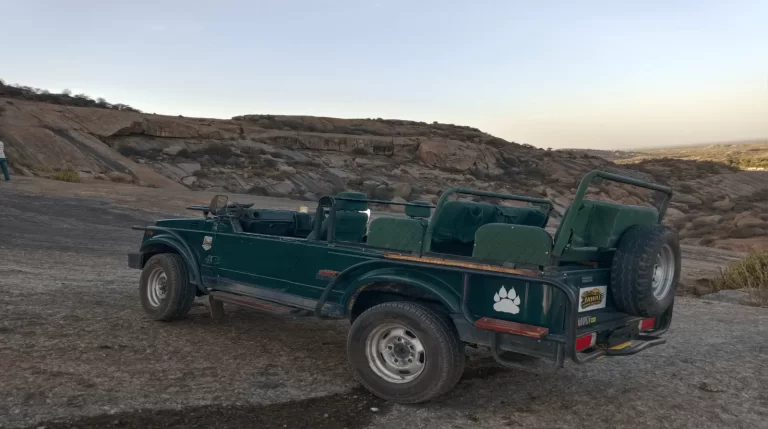
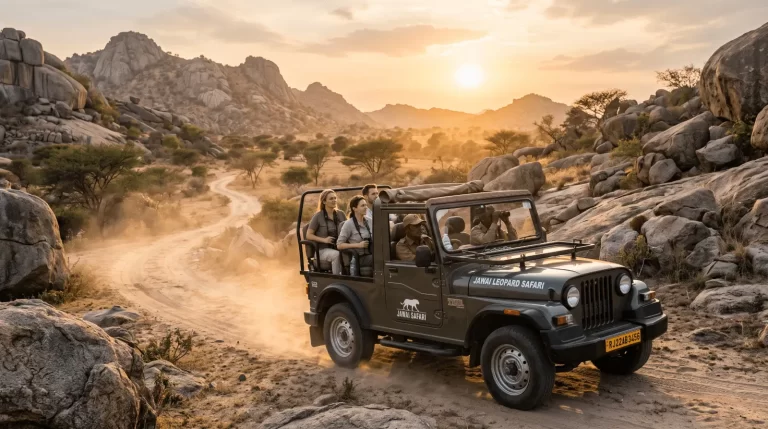
Only vehicles registered with the coordination committee may legally run commercial safaris in the Jawai area. This closes off the previous situation where any vehicle and driver could offer a safari with no external oversight. For visitors, this means the question of whether a vehicle is registered is no longer a nice-to-know detail, it’s the basic test of whether the safari you’re booking is legal at all.
Mandatory GPS Tracking
Every registered vehicle must carry a functioning GPS tracker at all times during operation. This gives the committee, and by extension the Forest Department, real-time and historical visibility into where safari vehicles actually go, which routes they take, whether they stay within permitted hours, and whether they deviate into restricted or off-track areas. This is arguably the single most consequential technical requirement in the order, since it converts rules that were previously unenforceable in practice, no one could really verify after the fact whether a vehicle drove off-track or stayed out past dark, into rules with an actual, checkable record behind them.
Fixed Daylight Operating Hours
Safaris are now restricted to a window of roughly 6am to 7pm. This directly ends the practice of night safaris, which had become a way for some operators to offer near-guaranteed sightings using artificial light, at real cost to the animals’ natural behaviour and rest patterns. We cover the specific reasoning behind this ban in more depth in a dedicated piece on why night safaris are banned in Jawai.
Bans on Specific Practices
Beyond the hours restriction, the SOP explicitly bans spotlighting, using artificial light to illuminate wildlife after dark, drone use over the safari area, baiting, using food to lure animals into view, and call playback, broadcasting recorded animal sounds to provoke a response. Each of these bans targets a specific practice that had become part of how some operators manufactured sightings for paying guests, at a real cost to the wildlife and habitat. All four are treated as serious violations under the enforcement structure described below.
Enforcement: Suspension and Blacklisting
The committee has the authority to suspend a vehicle’s registration for a first or lesser violation, and to permanently blacklist a vehicle for serious or repeated violations. Blacklisting means the vehicle cannot legally operate a commercial safari in Jawai again under that registration. Because GPS tracking makes violations verifiable rather than a matter of hearsay, this enforcement mechanism has real teeth in a way that simply didn’t exist before the order.
Freeze on New Licences and Construction
The order also froze the issuance of new tourism licences and new construction in the Jawai area pending further court review. This affects the broader tourism infrastructure around Jawai, not just safari vehicles, and it means the current landscape of registered operators and existing accommodation is close to a fixed set for the time being, rather than an actively growing and changing market.
Possible Sanctuary Declaration
The court has asked the state government to examine whether Jawai should be formally declared a wildlife sanctuary. This has not happened as of this writing, but it represents a possible further structural change, likely bringing an even more formal permit and zoning system similar to what exists at India’s tiger reserves. This is worth watching if you’re planning travel further into the future, though it does not change anything about how the current committee-registration system works today.
What This Means Practically for Your Trip
For a visitor, the order translates into a handful of concrete, checkable facts about any safari you book. The vehicle should be registered with the coordination committee and carry a visible GPS tracker. The drive should start and end within the roughly 6am to 7pm window, with no suggestion of extending into darkness regardless of how close a sighting feels. No spotlights, drones, bait, or recorded calls should appear at any point in a legitimate drive. And no legitimate operator should promise a guaranteed sighting, since the order doesn’t change the fundamental fact that this is a wild, unfenced leopard population behaving according to its own patterns, not a managed exhibit.
What Hasn’t Changed
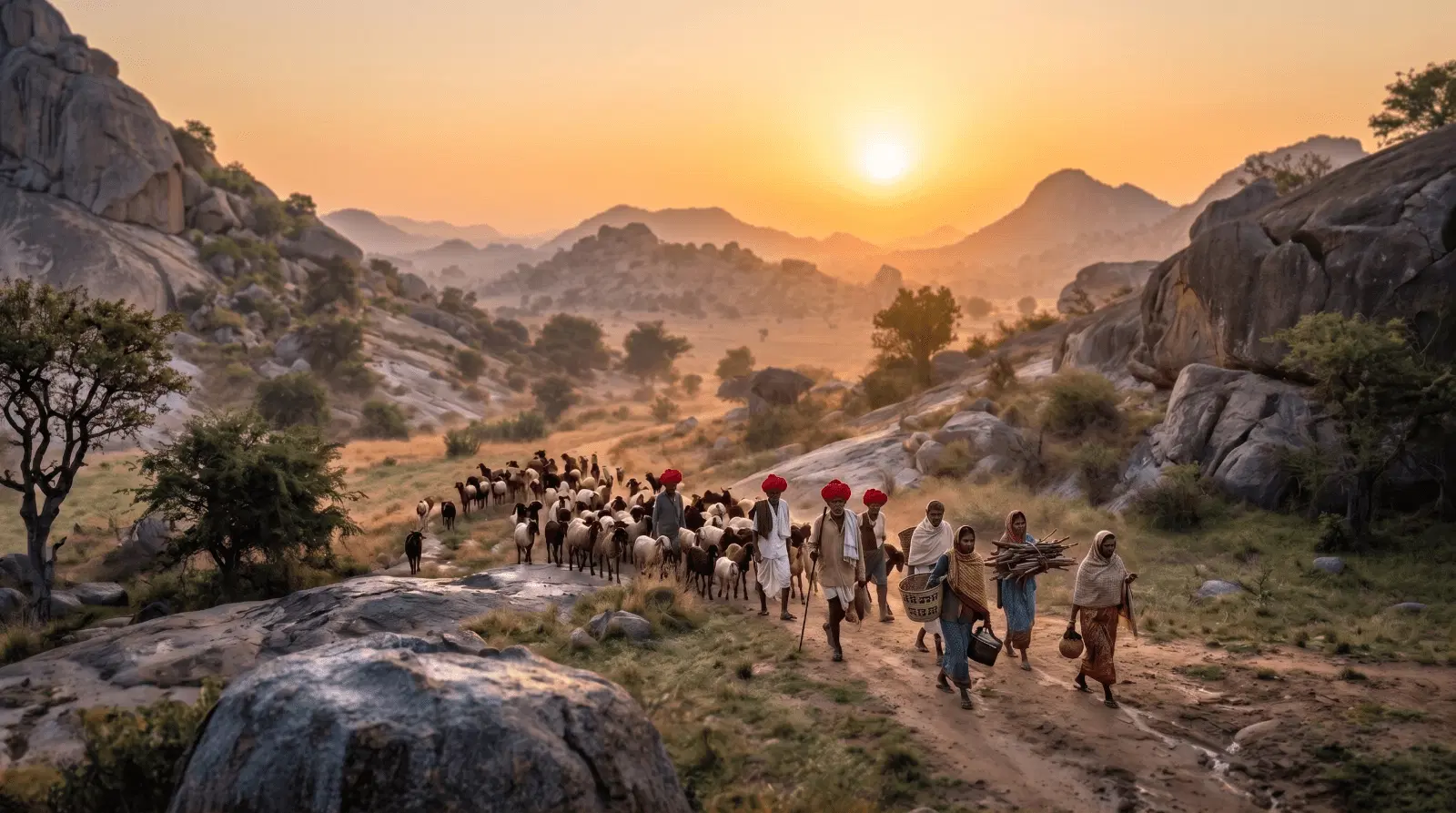
It’s worth being clear about what the order didn’t do, since some visitors assume a regulatory overhaul means a completely different experience. The fundamental character of a Jawai safari, open granite hill terrain, a mix of community and private land rather than a fenced reserve, the specific coexistence between leopards and the Rabari pastoralist community, remains exactly as it was. The skill and local knowledge that make a good naturalist good, reading terrain, understanding recent activity, positioning a vehicle respectfully around a sighting, are unaffected by the order, which regulates conduct and compliance rather than replacing the underlying expertise that has always defined a strong Jawai safari.
Why This Was Overdue, Not Excessive
It’s easy to read a list of new restrictions as bureaucratic overreach on a previously well-functioning system, but that framing misses what was actually happening in parts of the pre-2026 market. Practices like spotlighting and baiting weren’t a hypothetical risk being pre-emptively regulated, they were documented, real behaviours putting genuine pressure on a wild population and the delicate coexistence with the Rabari community that makes Jawai unique in the first place. The order formalises what the more responsible end of the operator market was already largely doing voluntarily, and closes the gap that let less scrupulous operators undercut them on both price and marketed sighting odds.
How We’ve Adjusted to the New Rules
We work exclusively with committee-registered, GPS-tracked operators, and we treat every provision described in this article as a baseline requirement for anyone we recommend, not an aspiration. If you have questions about how any specific part of the order affects your planned trip, timing, group size, whether you’re hoping for a photography-focused drive, message us on WhatsApp for current pricing and a quote tailored to your dates and group size, and we’ll walk you through exactly how a compliant safari will look for your specific circumstances.
Before and After: A Quick Comparison
- Vehicle registration: Previously informal and unregulated. Now requires formal registration with the coordination committee, with the possibility of suspension or blacklisting for violations.
- Tracking: Previously no tracking existed. Now every registered vehicle carries a mandatory GPS unit, giving the committee real-time and historical visibility into vehicle movement.
- Operating hours: Previously informal, with some operators running after dark. Now fixed to roughly 6am to 7pm, with night safaris banned outright.
- Spotlighting, baiting, and playback: Previously used by some operators to manufacture sightings. Now explicitly banned, with real enforcement consequences.
- Drones: Previously used occasionally for aerial footage. Now banned over the safari area entirely.
- New licences and construction: Previously an actively growing market. Now frozen pending further court review.
- Accountability: Previously reputation-based and informal. Now backed by a formal registry, tracking data, and a genuine suspension and blacklisting process.
Frequently Misunderstood Points
A few aspects of the order tend to get misreported or misunderstood as the news has circulated, worth clarifying directly. The order does not ban safaris altogether, nor does it cap the total number of visitors allowed into the area on a given day in the way some assume a court order of this kind might. It regulates who can legally operate a commercial vehicle and how, rather than restricting visitor numbers directly. It also does not, at least not yet, formally divide the safari area into numbered zones with individual entry permits the way a tiger reserve’s core zone works, zone selection remains an operational decision made by naturalists based on conditions, not a fixed allocation assigned to your booking. And it does not apply only to foreign-facing or premium operators, the registration and compliance requirements apply uniformly to every commercial vehicle regardless of price point or target market.