Can You Really See Leopards in Jawai? Honest Odds from the Ground
A Jawai safari looks, from the outside, like a jeep and a driver moving across open granite hill country hoping to get lucky. In practice, a well-run safari is a coordinated operation involving specific equipment, a communication network between vehicles, and a set of practices that have become considerably more structured since the 2026 regulatory changes. This article covers the gear a naturalist actually carries, how radio and phone-based coordination works between registered vehicles, and how sightings get shared across a zone without turning into a crowd around a single resting leopard.
The Basic Kit Every Naturalist Carries
Beyond the obvious, a driver and a vehicle, a properly equipped Jawai safari carries a specific, practical set of tools that support the actual work of finding and interpreting wildlife activity across open terrain.
Binoculars
A good pair of binoculars is the single most-used piece of equipment on any drive, more so than any camera. Distances in Jawai’s open granite terrain are often considerably longer than in dense forest, where sightings tend to happen close to the track simply because visibility is limited to begin with. Here, a leopard resting on a distant rock face might be identifiable and watchable from several hundred metres away, and binoculars are what actually make that possible, both for spotting activity in the first place and for extended, respectful observation without needing to approach closer.
Spotting Scopes
Some naturalists carry a spotting scope, particularly useful for very distant sightings or for showing a group fine detail, like a leopard’s exact position on a rock ledge, that binoculars alone might not resolve clearly. This is less universal than binoculars but increasingly common among experienced guides who specialise in longer, patient sightings over quick drive-bys.
Two-Way Radios and Phone Networks
Communication equipment, either handheld two-way radios or a dedicated phone-based messaging network, connects registered vehicles operating in the same zone on a given morning or evening. This is the backbone of how sighting information moves across the safari area in real time, and it’s worth understanding in some detail because it directly affects both your odds of a good sighting and the etiquette around approaching one.
GPS Trackers
Since 2026, every committee-registered vehicle carries a mandatory GPS tracker, generally a small unit mounted in or near the dashboard. This isn’t optional guide equipment in the way binoculars are, it’s a compliance requirement tied directly to the vehicle’s registration status, and its presence is one of the clearest, checkable signs that you’re in a legitimately operating vehicle.
Basic Field References
Many naturalists carry a compact field guide or reference material covering the birds and mammals found around Jawai and the dam, useful less for identifying the leopard itself, which any experienced guide knows on sight, and more for the wide range of other wildlife a drive turns up: raptors, waterbirds near the dam, smaller mammals, and reptiles that a less specialised driver might not confidently identify.
How Sighting Information Actually Moves Between Vehicles
When a naturalist spots a leopard, or strong signs of one, fresh pugmarks, a specific alarm call pattern from langurs, they typically relay this over radio or the phone network to other registered vehicles in the zone. This might sound like it would produce exactly the crowding problem the 2026 rules are trying to prevent, and it can, if handled poorly, but a well-run network includes real etiquette around how this information gets used.
Good practice generally looks like this: the first vehicle on a sighting gets priority positioning and a reasonable window of uncrowded viewing before other vehicles are directed in. Additional vehicles approach one at a time rather than converging simultaneously, positioning themselves so multiple jeeps aren’t clustered in a way that pressures the animal. Naturalists communicate not just the location but the leopard’s apparent state, resting calmly versus alert and likely to move, which affects how quickly and how closely subsequent vehicles should approach, if at all. A naturalist who receives a sighting report but judges that enough vehicles are already present will often choose to hold back or explore a different area entirely, prioritising the animal’s comfort and the group already present over adding another vehicle to the count.
Why This Coordination Matters More Since 2026
Before formal registration and GPS tracking, there was no reliable way to know how many vehicles were converging on a single sighting at a given moment beyond word of mouth and what a driver could see with his own eyes on approach. The combination of a shared radio network and traceable vehicle movement has made it more possible to actually manage this, both informally, through better real-time information sharing, and formally, since the coordination committee’s visibility into vehicle movement creates some accountability for operators whose vehicles are documented converging excessively on single locations in ways that could constitute harassment of wildlife.
What Good Coordination Looks Like From the Back Seat
As a guest, you’re unlikely to hear the radio traffic directly in detail, most of it happens in Hindi or the local Marwari dialect and moves quickly, but you can observe its effects. A well-coordinated sighting feels unhurried: your vehicle arrives, finds a reasonable position, and settles in without a scramble. If other vehicles are present, there’s a sense of order to how they’re positioned rather than a chaotic cluster. If your naturalist chooses not to pursue a reported sighting because too many vehicles are already there, that’s a sign of good judgment rather than a missed opportunity, since a crowded sighting rarely produces a good experience or a comfortable animal.
What Poor Coordination Looks Like
The opposite pattern is worth recognising too: multiple vehicles racing toward the same reported location, jockeying for the closest position, engines running unnecessarily close to a resting animal, and drivers on the radio audibly competing for position rather than sharing information cooperatively. This pattern was more common in Jawai’s pre-2026, less regulated environment, and while the new rules and enforcement have reduced it, it hasn’t disappeared entirely, particularly among vehicles operating at the margins of compliance.
How to Tell You’re With a Well-Equipped, Well-Coordinated Operator
- The vehicle carries visible binoculars, and ideally offers you a pair to use directly rather than only the naturalist looking through their own
- You can see or hear evidence of radio or phone-based coordination happening calmly, not frantically
- A visible, functioning GPS tracker is mounted in the vehicle
- Your naturalist explains, without being asked, why they’re approaching a sighting a certain way, or choosing not to approach one at all
- Approaches to any sighting are unhurried and considerate of other vehicles already present
Booking an Operator Who Gets This Right
The equipment and coordination systems described here aren’t dramatic differentiators you’d necessarily notice on your own without knowing to look for them, which is exactly why vetting an operator’s actual practices matters more than judging by a vehicle’s outward appearance alone. We work with registered operators whose naturalists carry proper equipment and participate genuinely in the shared coordination network, rather than treating radio contact as a race to the next sighting. Message us on WhatsApp for current pricing and a quote tailored to your dates and group size, and we’ll match you with an operator whose approach to gear and coordination reflects the standards described here.
The Vehicles Themselves
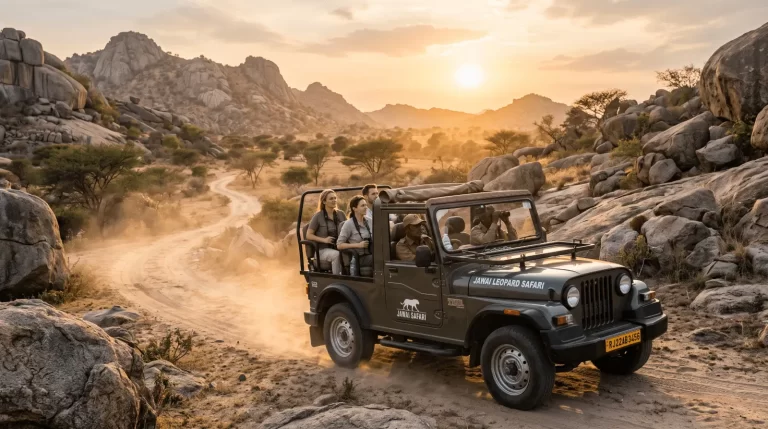
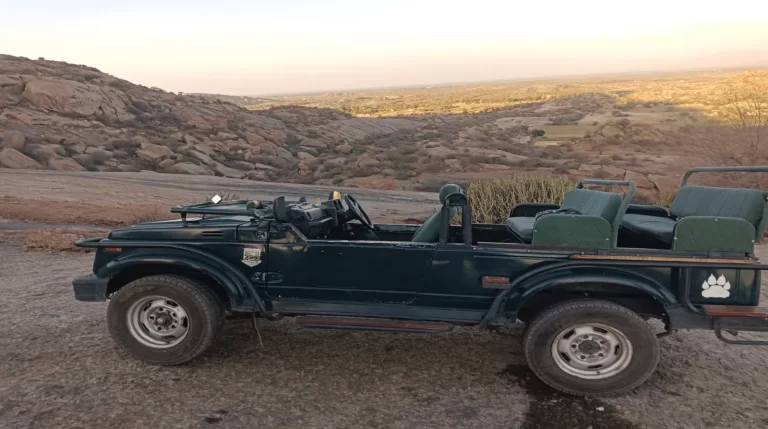
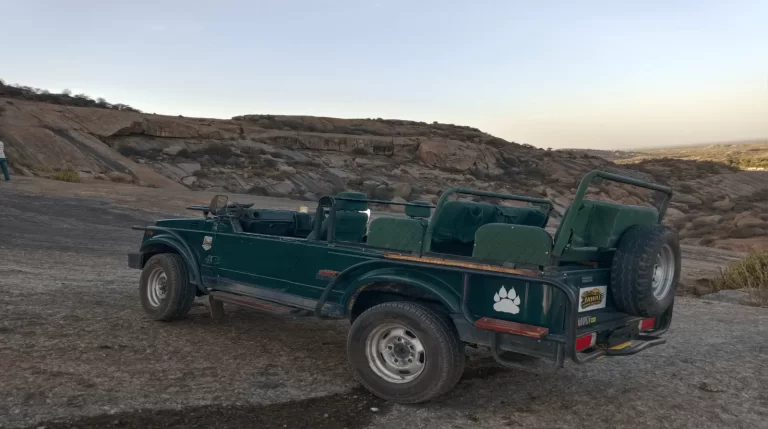
Most Jawai safaris run in open, modified four-wheel-drive vehicles built to handle the mix of terrain a drive covers, dry riverbeds, rocky tracks skirting the granite hills, and stretches of village road. Open-sided vehicles are strongly preferred over closed ones, both because they give guests an unobstructed view and photography angle in every direction, and because the terrain sometimes calls for careful, low-speed manoeuvring where visibility around the vehicle matters. A functioning four-wheel-drive system is not a luxury add-on here, it’s a practical necessity for reaching some of the rockier tracks safely, particularly after monsoon when riverbeds can still hold water and softer ground exists in patches. Seating is generally arranged in tiered rows facing forward and outward, giving every seat a reasonable sightline rather than clustering everyone toward one side.
Radio Protocol in More Detail
The actual mechanics of radio coordination follow a loose but real protocol among experienced operators. A spotting vehicle typically reports a general area rather than an exact pinpoint location over open channels, partly to avoid an immediate rush and partly because the animal may move before other vehicles arrive anyway. Follow-up detail, exact positioning, the animal’s behaviour, whether it’s approachable from a certain angle, is often relayed more precisely once a second vehicle is already close enough to benefit from it. Some operators use coded shorthand over radio for common situations, a quick phrase indicating a resting sighting versus a moving one, for instance, both for speed and because channels are sometimes shared across multiple operators who might not need every detail of a competitor’s exact conversation. None of this is secretive in a problematic sense, it’s simply the practical language that develops among people doing the same specialised job in the same landscape for years.
What Happens When Equipment Fails
Radios lose signal in some of the deeper folds of the granite hills, and GPS units occasionally have connectivity issues given the remote terrain. A well-prepared operator has a fallback plan for this, generally a pre-agreed rendezvous point or time check-in with other vehicles in the zone, rather than relying entirely on continuous radio contact. This matters less to your direct experience than the other factors described here, but it’s part of what separates an operator with genuine operational discipline from one running on an ad hoc basis, and it’s reasonable to ask about if you’re booking through an operator directly rather than through a curation service that has already vetted this.