Leopard Cubs in Jawai: The Season and the Zones Where Mothers Appear
Of all the sightings a Jawai safari can offer, none draws more excitement, and requires more restraint, than a mother leopard with cubs. It is also one of the more misunderstood parts of Jawai’s wildlife calendar, because unlike the flamingo arrivals at the dam or the monsoon greening of the hills, leopard breeding in Jawai does not follow a single, clean seasonal window. Understanding what is actually known about timing, and understanding why responsible viewing matters more here than almost anywhere else, are both necessary before treating a cub sighting as something to actively chase.
Leopard Breeding Does Not Follow a Fixed Season
Unlike many temperate mammals, leopards across their range, including in Jawai, do not breed on a strict annual cycle tied to a single season. Females can come into estrus at various points across the year, and births in the wider Bera-Jawai landscape have been documented across multiple months rather than clustering into one obvious cub season the way, for example, migratory bird arrivals cluster into autumn and winter. This means there is no honest way to tell a prospective guest “come in this specific month for the best chance of cubs” the way it is possible to say that for flamingos at the dam.
What can be said, based on patterns observed over years of tracking resident females across the zones, is that certain windows tend to see a higher concentration of den emergences and early cub sightings than others, generally correlating with periods of greater prey availability following good rains, when a mother has more reliable hunting success and is more likely to risk moving cubs to more exposed rock formations. But this is a tendency, not a rule, and any operator promising cubs on a specific date range is overstating what the evidence actually supports.
Where Mothers Choose to Den
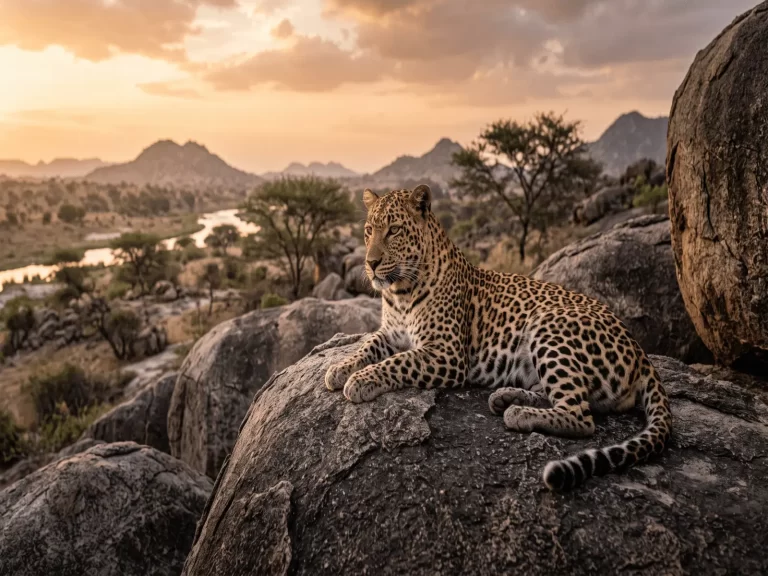
The choice of den site says a great deal about how Jawai’s terrain shapes leopard behavior even in its most vulnerable moments. A mother leopard with newborn cubs needs a site that is both defensible and thermally stable — protected from extreme heat, from monsoon flooding, and from other predators, including, occasionally, other leopards. Jawai’s granite kopjes offer an unusually good supply of such sites: deep boulder crevices, shallow caves formed where large slabs have split and settled against each other, and rock overhangs tucked into the interior of larger formations, away from the more exposed faces where an adult leopard might comfortably rest alone.
These den sites are typically deep within a formation, not visible from a jeep track, and mothers are highly selective about them, often maintaining knowledge of multiple potential den sites within their territory and switching between them if disturbed or if a site becomes compromised. This means the cub-viewing opportunities that do exist are almost never sightings of very young, days-old cubs at a den mouth. They are, far more commonly, sightings of cubs old enough to have begun following their mother on short exploratory movements away from the den — typically several weeks to a few months of age, once mobility and coordination have developed enough for a mother to risk bringing them into more open territory for short periods.
Which Zones Have Produced Documented Cub Sightings
All three of Jawai’s commonly referenced safari zones — Bera, Sena, and Devgiri — have had resident females raise cubs successfully in past years, and none holds an exclusive claim on the experience. That said, the zones differ somewhat in the density and accessibility of suitable denning terrain. Bera, with its long safari history and well-documented resident leopard families, has produced some of the more consistently followed cub-rearing stories over the years, partly because trackers there have built up multi-year familiarity with specific females and their territories. Sena and Devgiri have their own resident females and their own denning history, and in any given season, activity can shift toward whichever zone currently has a female raising a litter old enough to be occasionally visible.
This is worth stating plainly: which zone is “active” for cubs changes from season to season and sometimes within a season, depending on which females are currently denning, how old their cubs are, and whether recent disturbance has caused a mother to relocate. A guide with current, on-the-ground knowledge of which territories have active litters this month is a far more useful resource than any general claim about which zone is historically best for cubs.
What a Cub Sighting Actually Looks Like
Visitors sometimes arrive expecting a scene resembling wildlife documentary footage — cubs tumbling in open play, fully exposed, for extended periods. The reality in Jawai, as in most wild leopard populations, is more restrained. A typical cub sighting involves a mother moving cautiously across a section of open rock with one or more cubs following closely, often pausing frequently to watch her surroundings, or cubs visible briefly near the mouth of a den site before retreating back inside at any unfamiliar sound or movement. These moments tend to be brief, and mothers are acutely sensitive to any sign of disturbance, particularly vehicle noise, raised voices, or sudden movement from observers.
Why Responsible Viewing Matters More With Cubs Than With Adults
An adult leopard resting alone on a rock face has considerable behavioral flexibility if disturbed — it can simply retreat further into a crevice or move to another part of its territory. A mother with young cubs has far less flexibility, and the stakes of disturbance are correspondingly higher. A mother that feels her cubs are exposed to a persistent threat, including a jeep that lingers too long, approaches too closely, or returns repeatedly to the same den area, may abandon a den site altogether and relocate cubs to a less optimal location, at real cost to their safety and her own hunting efficiency during a period when both matter enormously.
This is why any operator worth working with in Jawai treats cub sightings with more caution than adult sightings, not less. Practically, this means maintaining greater distance from a known den area than would be necessary for an adult sighting, keeping visit duration short even when cubs are visible and cooperative, never repositioning a vehicle to get a “better angle” once cubs have reacted to the vehicle’s presence, and never returning to the same den site multiple times in a single day regardless of guest demand. Reputable local trackers also observe informal, community-level restraint around known den locations during the most sensitive early weeks after cubs are first sighted, deliberately routing safari traffic away from a specific formation until cubs are older and more resilient to disturbance.
The 2026 Rules and Cub Viewing Specifically
The daylight-only safari regulations introduced in 2026, alongside the requirement for GPS-tracked, committee-registered vehicles only, have an incidental but genuinely positive effect on cub viewing specifically. Removing night safaris and spotlighting eliminates a form of disturbance that was particularly risky around den sites, where sudden artificial light at close range could plausibly startle a mother into abrupt relocation. The current framework, which restricts all safari activity to a fixed daylight window and requires GPS tracking of every vehicle, also makes it considerably easier for the coordination committee to identify and act on any vehicle that lingers inappropriately near a known den, since vehicle positions and dwell times are logged rather than informally observed.
How Long Cubs Stay Close to the Den
Understanding the rough developmental timeline helps set realistic expectations for what any given sighting is likely to show. Newborn leopard cubs are blind, largely immobile, and entirely dependent on the den for the first several weeks of life, during which a mother leaves them only to hunt and returns to nurse and groom them, moving them between backup den sites if she senses any disturbance. It is only once cubs are mobile enough to keep pace on short walks, generally at an age where their coordination and stamina have developed sufficiently, that a mother begins allowing them limited excursions beyond the immediate den area, usually still within a tightly defined radius and always with the option to retreat quickly back to cover.
Even at this stage, cubs remain highly dependent, and a mother’s tolerance for a vehicle’s presence during these early excursions is considerably lower than her tolerance as an unaccompanied adult. It is not until cubs are considerably older, approaching independence, that they begin ranging more freely with their mother across a larger portion of her territory, at which point sightings become somewhat more frequent and somewhat less fragile, though still deserving of the same baseline respect given to any resident leopard.
What Guides Watch For Before Approaching
Experienced trackers read a specific set of behavioral cues before deciding whether, and how closely, to approach a sighting involving cubs. A mother who is relaxed, moving at a normal pace, and allowing cubs to remain visible and active is generally tolerating the vehicle’s presence reasonably well at a sensible distance. A mother who freezes, stares fixedly at the vehicle, or begins moving cubs toward cover is signaling discomfort that should be respected immediately by increasing distance or leaving the area entirely, not by waiting to see if she settles. Cubs themselves often signal distress before their mother does, freezing or retreating toward her at the first sign of an unfamiliar sound, and a good guide treats a cub’s reaction as seriously as a mother’s.
This kind of reading takes practice and repeated exposure to know a specific mother’s typical behavior, which is another reason continuity of local guiding knowledge matters so much here — a tracker who has followed a particular female across multiple seasons has a far better baseline for judging what counts as normal, relaxed behavior versus early signs of stress in that specific individual, compared to someone encountering her for the first time.
What to Actually Expect
Anyone planning a trip with cub sightings as a specific hope should treat it exactly as that — a hope, not an itinerary item. There is no month that reliably delivers cubs, no zone that guarantees them, and no operator who can honestly promise them without either overstating current den activity or, worse, being willing to push a vehicle closer to a den than is responsible in order to deliver on a promise. What a good operator can offer is current knowledge: which territories have documented recent activity, how old any known litters currently are, and an honest read on whether a sighting is realistically possible during your specific dates, alongside a firm commitment to viewing any cubs found at a respectful distance and for a limited time, regardless of how eager the vehicle’s occupants are to stay longer.
Message us on WhatsApp for current pricing and a quote tailored to your dates and group size.