Crocodiles of Jawai Dam: The Sighting Most Guests Don’t Expect
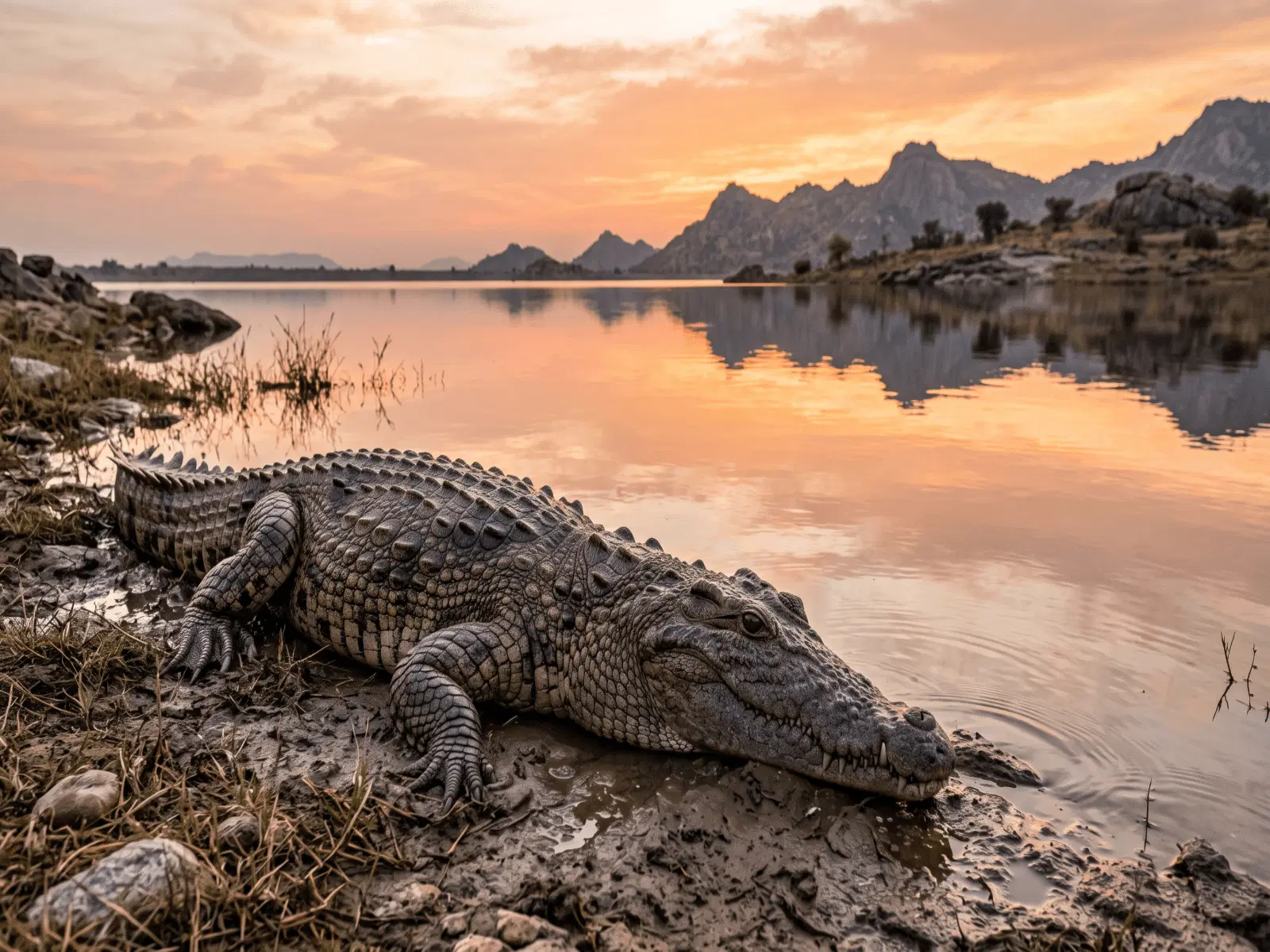
Almost nobody arrives in Jawai expecting crocodiles. Every piece of pre-trip research a traveler does — the leopard population, the granite hills, the Rabari villages — points toward a dry, rocky, quintessentially Rajasthani landscape, and crocodiles simply do not fit the mental picture most people build in advance. Then the jeep comes around the last bend of Jawai Bandh, the dam that gives this whole landscape its name, and there, basking motionless on the exposed mud and rock of the shoreline, is a mugger crocodile that has clearly been there for a very long time and is in no hurry to move. It is, for a large share of first-time visitors, the single most surprising sighting of the entire trip.
How a Freshwater Crocodile Ended Up in the Middle of Rajasthan
The mugger crocodile, also known as the marsh crocodile, is a freshwater species native across the Indian subcontinent, historically distributed through rivers, lakes, and marshes from Iran through to eastern India. It is not a species associated in the popular imagination with Rajasthan’s arid image, but muggers have always been present in the region’s larger, more permanent water bodies wherever those exist — and Jawai Bandh, completed in 1957 as a drinking water and irrigation reservoir for Pali district, created exactly the kind of large, stable, food-rich freshwater habitat this species needs to establish a genuinely resident, breeding population.
This is worth underlining because it is easy to assume a wildlife feature this established must have deep historical roots, when in fact the crocodile population here is a direct, unplanned consequence of a mid-twentieth-century infrastructure project. Before the dam, the Jawai river’s seasonal flow would not have supported a large, stable mugger population through the dry months in anything like the numbers now present. The dam’s construction, built purely for water supply and irrigation with no conservation intent whatsoever, incidentally created the reservoir conditions muggers need: a large body of water that persists through the dry season, with enough associated marsh, backwater, and shoreline habitat to support denning, basking, and a reliable prey base.
What Muggers Actually Do at Jawai Bandh
Muggers are, for most of the day, remarkably still animals, and this is central to understanding why they are so often visible rather than hidden. Unlike leopards, which use Jawai’s terrain to remain physically inaccessible while resting in full view, crocodiles rely on stillness itself as camouflage and energy conservation — a basking mugger on a muddy bank or a partially submerged rock can look, at a distance, indistinguishable from a log or a shadow until it moves, which it does infrequently and usually only when genuinely disturbed or when temperature regulation demands it.
Basking is a thermoregulatory necessity for a cold-blooded reptile, and Jawai’s muggers spend a considerable portion of daylight hours doing exactly this, hauled out on exposed mud flats, sandy shoreline, or flat rock slabs near the water’s edge, absorbing heat before returning to the water to cool down or to hunt. This basking behavior is most visible and most reliable during the cooler months, when the temperature differential between air and water makes basking thermally worthwhile for longer stretches, and considerably less visible during the hottest parts of the year and the height of summer afternoons, when muggers are more likely to remain submerged with just eyes and nostrils above the waterline to avoid overheating.
Water Level and Crocodile Visibility
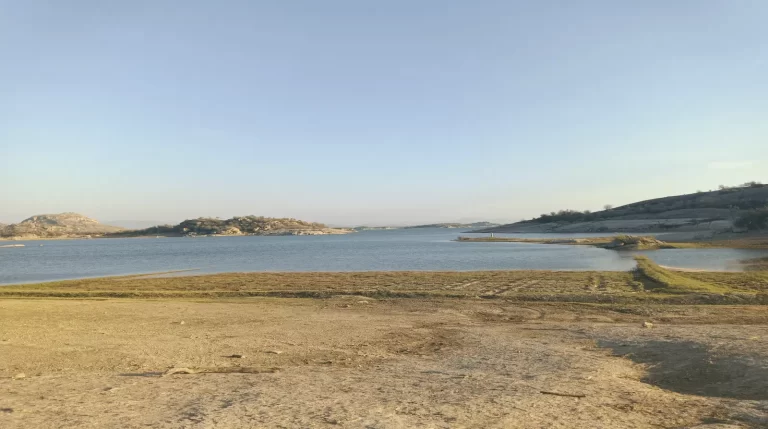
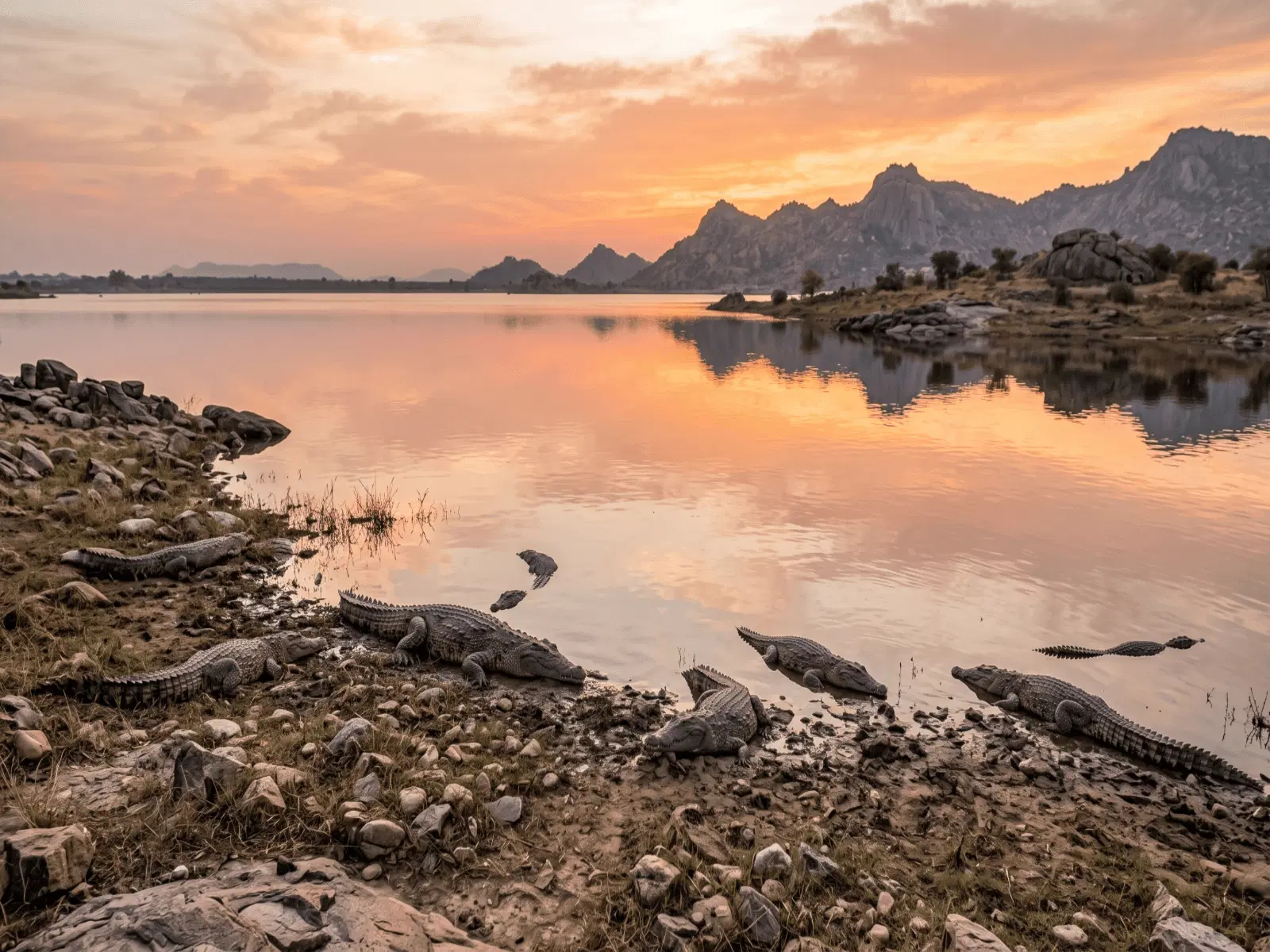
The single biggest practical factor in whether a given safari or dam visit produces a crocodile sighting is the water level, which fluctuates significantly across the year depending on monsoon performance. As the dam’s water recedes through the dry months, following a typical monsoon, more shoreline, mud flat, and sandbank become exposed, and muggers concentrate more visibly along these exposed margins, often in loosely clustered basking groups rather than spread thinly around a full reservoir edge. During and shortly after a strong monsoon, when the dam is fuller and the shoreline is largely submerged, crocodiles have far more concealed water to retreat into and are correspondingly harder to spot from a vehicle or viewpoint on the bank.
This means the best months for a confident crocodile sighting tend to be the drier stretches of the year, when shoreline exposure is at its greatest, rather than the immediate post-monsoon period when the dam is at its fullest and most photogenic from a landscape perspective. Anyone specifically hoping for crocodiles, rather than simply hoping to see the dam at its most visually dramatic, should ask current questions about water level rather than assuming any single month is automatically best.
How Muggers Fit Into the Wider Dam Ecosystem
Crocodiles are not an isolated curiosity at Jawai Bandh; they are one part of an ecosystem the dam created almost entirely by accident. The same concentration of water and prey that draws nilgai, chinkara, and livestock to the dam’s margins, and that in turn concentrates the leopard population in the surrounding hills, also supports the fish, waterbirds, and smaller aquatic life that make up the bulk of a mugger’s diet. Muggers are opportunistic predators, taking fish as a dietary staple but also capable of taking birds, small mammals, and on occasion livestock that wander too close to the water’s edge — an interaction that, like leopard predation on livestock, is a real if infrequent cost that the surrounding pastoral community has learned to manage rather than eliminate.
The dam’s crocodiles also share their habitat, seasonally, with the migratory birds that arrive from around September through the winter months — flamingos, demoiselle cranes, and a wide range of other waterbirds drawn to the same reservoir. This overlap is worth noting because muggers and large wading or swimming birds share water space without the crocodile population posing an obvious mass threat to bird numbers; the relationship is more a matter of shared habitat use than active predator-prey dynamics for most species involved, though opportunistic predation on smaller or injured birds certainly does occur.
Where and How Sightings Typically Happen
Crocodile sightings at Jawai are generally a dam-based experience rather than a hill-based one, meaning they occur on dedicated visits to the dam itself, on the drive along its shoreline roads, or as an incidental sighting during a safari route that happens to pass close to the water. Some operators run dam-specific outings that combine birdwatching and crocodile viewing as a distinct experience from the hill-focused leopard safari, and this is often the more productive way to guarantee time spent specifically looking for muggers rather than treating a crocodile sighting as an incidental bonus on a leopard-focused drive.
Sightings tend to cluster around specific stretches of shoreline where basking conditions are most favorable — typically areas with a gentle mud or sand slope rather than steep rocky banks, and often near backwater inlets where the water is shallower and calmer. A guide with current knowledge of the dam’s present water level and recent crocodile activity can usually predict which stretch of shoreline is most likely to be productive on a given day considerably better than a generic recommendation to “visit the dam.”
Respecting the Distance
Muggers are wild, physically capable predators, not a passive photo backdrop, and the same ethical distance principles that apply to leopard viewing apply here. Approaching too closely on foot, especially near water where a crocodile could react quickly, is neither safe nor responsible, and any viewing should be conducted from an appropriate distance, typically from a vehicle or a designated safe vantage point along the shoreline rather than at the water’s edge itself. This is not a dramatic risk under normal, sensible circumstances, but it is a real one, and treating a basking mugger as approachable because it appears motionless is a genuine and avoidable mistake.
How Muggers Differ From the Crocodiles Travelers May Have Seen Elsewhere
Travelers who have encountered crocodiles elsewhere in India or on trips to Africa sometimes arrive with assumptions shaped by a different species entirely. Muggers are generally less aggressive toward large mammals than the Nile crocodile of African rivers, and considerably more habituated to a landscape shared closely with people and livestock, reflecting a long history of coexistence with village life around India’s traditional water bodies, not unlike the leopard-Rabari relationship in the surrounding hills. This is not a reason to treat them as harmless — they remain powerful, opportunistic predators capable of taking prey well within their reach — but it does mean the dynamic at Jawai Bandh is closer to wary mutual avoidance between muggers and the people who use the dam’s margins for grazing and washing than to the more visibly tense human-crocodile conflict seen in some other parts of the world.
Photographing Crocodiles at the Dam
Crocodile photography rewards a different approach than leopard photography, largely because the subject is so much more static. Rather than anticipating movement, the more productive technique is composing carefully around a basking animal’s position relative to the water line, the surrounding shoreline texture, and the light, since a mugger may remain in exactly the same pose for a considerable stretch of time. Early morning and late afternoon light, low and warm, tends to render the reptile’s textured hide far more strikingly than the flatter light of midday, and a basking crocodile with the granite hills or dam water as a backdrop is one of the more distinctive images available at Jawai precisely because so few visitors expect the opportunity and therefore few arrive prepared for it. A longer lens is generally preferable to a wide angle for a frame-filling shot, given the sensible distance viewing requires.
A Sighting Worth Building Into the Itinerary Deliberately
Because crocodile sightings are so often treated as an incidental bonus rather than a planned objective, many visitors miss them entirely simply because no part of their itinerary specifically allocates time at the dam’s shoreline. A short, dedicated stop at the dam, distinct from the hill-focused leopard safari, considerably improves the odds of a good, unhurried crocodile sighting compared to hoping one appears during a drive routed primarily through the granite formations further from the water. This is a simple planning adjustment, but it is the single most effective way to convert “we might see a crocodile” into a genuinely likely part of the trip.
Why This Sighting Matters Beyond the Surprise Factor
Beyond the simple novelty of an unexpected animal, the crocodile population at Jawai Bandh is a useful lens for understanding the entire landscape’s origin story. Nothing about this ecosystem — the leopards, the birds, the crocodiles, the concentrated prey base — was designed. It is the accumulated, unplanned consequence of a 1957 irrigation project that happened to create the right conditions for an entire regional ecology to reorganize itself around a single reservoir. A mugger crocodile basking on a Rajasthan dam bank is, in its own way, as good an illustration of that accidental ecosystem as a leopard resting on granite is.
Message us on WhatsApp for current pricing and a quote tailored to your dates and group size.